Here is your Daily AI Stew, served up by Robin.
Google: Gemini 4 Hydrogen ships, already replacing 3.8 Flash across the line-up
Google has pushed its newest fast tier of models, Gemini 4 Hydrogen, across the whole product line.
Google keeps naming new models after elements, and this one is Gemini 4 Hydrogen. The scheme is harder to read into than the early Pro and Flash, but Hydrogen's role is clear: it replaces the Flash tier most people in Google's ecosystem use, the faster and cheaper one. The earlier Argon and Carbon releases both rolled out in stages, starting with cybersecurity researchers, and even once generally available they were opened only to the highest-paying subscribers. Hydrogen's quota is far more generous, it was open immediately from the start, and it has already replaced Gemini 3.8 Flash across Google's products.
Google calls Hydrogen a major step up over the previous Flash generation. It has four thinking levels: low, medium, high, and a new xhigh; even at high it is 2.5 times faster than Flash 3.8. By Google's own analysis it cut "fabricated claims" by more than 5 times. On code generation, Hydrogen scores more than three times 3.8 Flash on Terminal-Bench. In some settings it even trades blows with the higher Argon tier: on the Artificial Analysis Intelligence Index, xhigh mode scores 54 and Argon 50.
The fast tier is the one most people really use every day, and its refresh cadence moves cost and default experience more than the flagship does. Google skipping the staged rollout and shipping straight out says it cares more about holding share than about winning credibility with researchers first. Two things are worth watching: whether the so-called fabricated-claims improvement still holds up in real long tasks, and whether finer and finer tiers make choosing one more expensive for developers. The previous two releases went to researchers first and high-paying users second; reversing the order this time also means a wider surface is affected if something goes wrong.
Anthropic: Fable 5.2 and Mythos 5.2 ship, with 1,000 agents formalising Fermat's Last Theorem in about 30 hours
The research side has an item too: Anthropic has pushed multi-agent systems straight onto mathematical proof.
Anthropic released Claude Fable 5.2 and Mythos 5.2. Fable 5.2 is positioned as a multi-agent system for complex research tasks, one that lets large numbers of agents divide the work on their own, coordinate, and drive a formal proof forward.
The release material says 1,000 Fable 5.2 agents formalised Fermat's Last Theorem in about 30 hours with minimal human intervention. The agents started from a minimal prompt, worked out a way to collaborate on their own, consulted no mathematical references, and used only a set of intermediate theorem statements as the scoring basis. For comparison, the earlier unpublished research version cited in the comments needed a purpose-built runtime and one human researcher guiding it, and took 11 days. If independently reviewed, this result could push AI-driven theorem formalisation and parallel research; but the evidence offered so far is limited, and the material also says little about Mythos 5.2's specific capabilities, positioning and availability.
Fermat's Last Theorem says that for an integer n greater than 2 there are no positive integers x, y, z satisfying xⁿ + yⁿ = zⁿ. Formalising it means rewriting the proof as a machine-checkable object a computer can verify, not just generating a natural-language argument. Anthropic's earlier first formalisation of the theorem used an unreleased research version of Claude and took 11 days; this time 1,000 agents established their own coordination, which tests model reasoning, multi-agent orchestration and formal verification at once.
For developers and institutions, Claude Fable 5.2 is now available through Claude Platform and Amazon Bedrock; Claude Mythos 5.2 is open only to cybersecurity and life-sciences advanced work vetted by Anthropic, and day-to-day use is still gated.
People who have actually tried it say Fable 5.2 is already strong, but on ordinary tasks it is often hard to tell apart from Opus 5.5, and the advantage only shows once task goals and complexity are raised substantially; another user says Opus 5.5 already handles a project of around 125,000 lines of code, and therefore questions whether Fable and Mythos answer a real, must-have workflow. Some in the community also think 5.5 may have been weakened because a new version shipped, and question the benchmarks in this release, including Carbon's anomalous effort-intel curve, the missing comparison against a single cybersecurity benchmark, and the Robodojo comparison switching to Argon rather than Carbon.
Writing a theorem as a machine-checkable object never allows vagueness: the checker pins down every step of reasoning, so the meaning of this class of result is not the theorem itself but whether a large number of agents can form their own division of labour and coordination. What really decides how much it weighs is independent review and the failure rate, and the evidence published so far cannot carry a stronger conclusion. The other point worth watching is the access gate, open only to vetted security and life-sciences work, which says the vendor is fitting capabilities of this size with a valve. For research teams this is more an experiment in how to collaborate than an assault on a theorem.
Reuters: Anthropic weighs an IPO at a valuation of about $1.4 trillion
The capital side has an item too, and it is the same company as the one just above.
Reuters reports that Anthropic is considering an initial public offering at a valuation of about $1.4 trillion; CNBC and others, citing people familiar with the matter, put the price range at $70 to $78 a share and the first-day valuation at about $1.3 trillion. All of these numbers come from media reports, and the final timing, pricing and valuation are not settled.
According to Reuters, Anthropic's updated IPO filing proposes to issue 825 million Class A shares at 70 to 78 dollars each, a valuation of up to about $1.4 trillion. Reuters says that level is slightly below some investors' expectations and reflects cooler enthusiasm for AI companies. Note that the figure in the original headline of that report does not match the $1.4 trillion valuation used in the copy, which is a difference in how outlets state it; this piece could not check the prospectus itself, so both numbers defer to the final filed document.
If the IPO goes ahead as planned, about 20% of the shares are to be allocated to retail investors, according to CNBC as relayed by ZeroHedge, and participants will be able to buy Anthropic directly at the IPO price. Its price performance once listed will test how much of the proposed $1.4 trillion valuation the market will bear.
The number itself is not the point; what is being tested is whether public markets will pay that price for a model company still investing at full speed, and whether leaving a fifth of the shares to retail investors amplifies first-day swings. The gap between the outlets' figures and the final document is also a reminder that valuations like this are still moving. For peers that need to raise later, its pricing and post-listing performance will become a reference point, and the pace of fundraising and the terms will most likely adjust with it. Once it actually lists, the buyer mix will say more than the first-day move.
Source: rss (relayed via Google News aggregation) · Reuters original
Grok Build: coding agent accused of leaking confidential data, some of it SpaceXSI's own
Security has an item today too, and the protagonist is a coding agent itself.
New research from the security firm Claroc shows that SpaceXSI's vibe-coding agent Grok Build is leaking data on thousands of users, including trade secrets and other sensitive information; even Musk's own company, which runs the platform, is among the victims.
The leak sits in the links Grok Build lets users share apps with. Grok supposedly randomises the URL so that only someone with the exact link can reach the corresponding data store; but a design decision by the platform's developers cancels that out completely, and anyone can enumerate thousands of running Grok Build projects. With a few exceptions, opening those links opens the app and exposes all the data attached to it.
The exposed data Claroc found includes internal business plans, advertising proposals, medical test results, the catering inspection checklist for a celebrity cruise line, and employee names and staff numbers. Ironically, part of the sensitive data comes from apps SpaceXSI (the merged SpaceX and xAI) built itself: Claroc found 24 documents in SpaceXSI's apps, and among the sampled ones an onboarding plan for the SpaceXSI enterprise sales team marked confidential, a sales territory map covering 594 customer accounts, internal system addresses for sales team tooling, and several advertising proposals.
The value of a coding agent is turning internal data into a working app in one step, and that is exactly where the problem sits: a default share link plus addresses that can be guessed one by one hands the data boundary to the user's own discipline. When a company adopts this class of tool, the scope of its permissions and how guessable its links are should be assessed together with the technical capability. For developers, it means asking "who can reach this" before shipping, not adding compliance steps afterwards. Accidents like this usually are not a break-in; they are defaults left in the open state.
TSMC: foundry plans to invest $1 billion in Anthropic and OpenAI
Up the supply chain, the foundry is starting to hold equity in its customers directly.
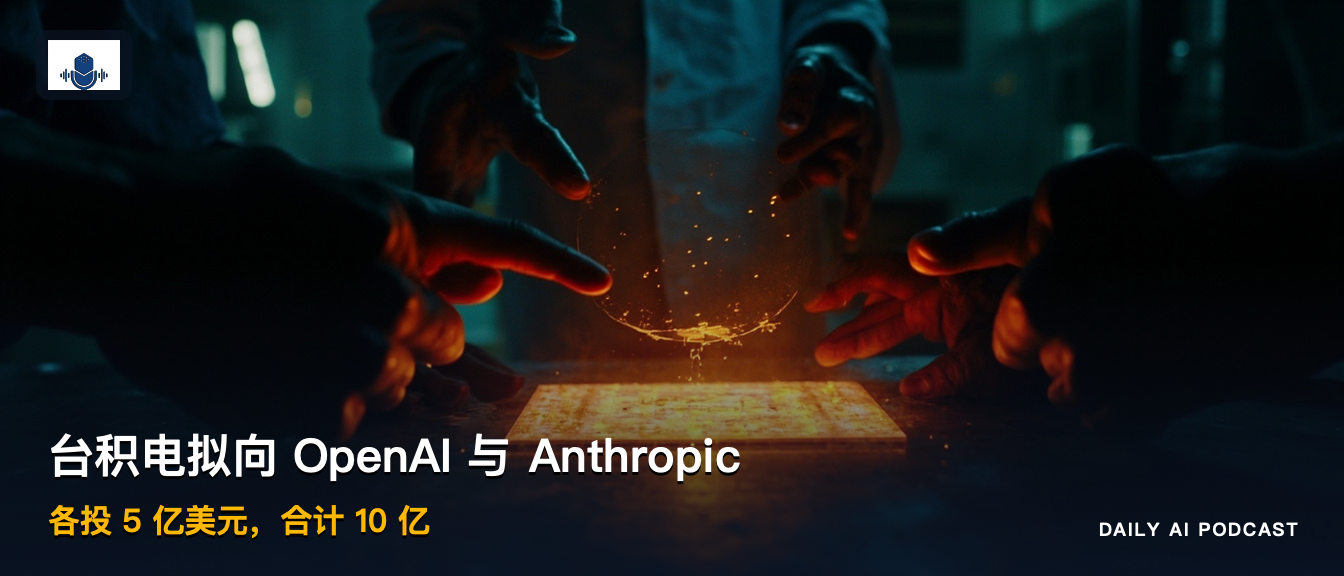
TSMC, the world's largest chip foundry, is preparing to invest $1 billion in Anthropic and OpenAI, and thereby hold shares directly in the two leading AI developers. In the build-out of AI data centres, TSMC's own foundry business has already been making money hand over fist.
According to Reuters, TSMC's board has approved using up to $500 million to subscribe to the preferred shares OpenAI reserved for large investors, and another $500 million to buy Anthropic common stock at its expected IPO price.
The Wall Street Journal reports that the investment may give the market "a shot of confidence", because AI trades have looked tired lately. But analysts also warn that this kind of circular financing between investors, suppliers and customers makes real demand for AI hardware and services harder and harder to assess.
The money is not large next to TSMC's size; the point is the posture. Once a supplier becomes a shareholder, capacity allocation and purchase negotiations gain a layer of overlapping identity. The analysts' worry is two sides of the same thing: when investor, supplier and customer overlap heavily, order figures stop being an independent demand signal. What to watch next is the lock-up period on these shares and how they are disclosed, which decides whether this is closer to a financial investment or a deep tie-up, and whether it can become leverage in the next round of compute negotiations.
Gemini: open-source project alleges consumer Gemini sends Gmail and Drive content to human review
On privacy there is also a community allegation, and the evidence boundary needs stating first.
The open-source GitHub project thisisme6598/gemini_files alleges that consumer Google Gemini may send the content of emails and files to human labellers for review once Connected Apps is enabled and Gmail or Google Drive is authorised. The key qualifier in the discussion is that the claim is about Consumer Gemini; the Workspace documentation cited in the comments says Workspace Gemini and the enterprise-facing Workspace Intelligence are not subject to human review. If the allegation is true, personal data users provide for personalisation could enter a human access workflow, raising concerns about the scope of consent, privacy notices and data governance. But the material so far offers no confirmation from Google, and no test method, trigger conditions or frequency from the project, so for now it can only be treated as an allegation raised by a community investigation, not as an officially confirmed fact.
In consumer Gemini, once a user authorises Connected Apps such as Gmail and Google Drive, the assistant can call on personal content in those services to finish tasks. Human labelling usually means staff checking model interactions or tool-call data to evaluate safety and quality; the open-source project claims that email bodies and cloud file content read through Connected Apps can therefore also enter human review. Commenters specifically distinguish Workspace Gemini from Workspace Intelligence, saying both still claim data is not subject to human review, so the consumer case cannot be extrapolated straight to enterprise Workspace products, and the allegation itself has no official confirmation from Google.
Google's official privacy documentation currently confirms only that Connected Apps information is stored and used to provide and improve Gemini, and does not confirm the specific scope of human review in this result. Several participants in the comments are unhappy with how the consumer version reaches email and files once a user grants permission; one user says Gemini's answer once lined up eerily well with a follow-up email, and other comments worry that human-labelled data is used for training or leaks, but none of these experiences or guesses can independently verify the core allegation.
The value of this item is not whether the allegation holds but the trust gap it exposes: users can hardly judge for themselves which internal steps their data passes through once they hand over email read access. The open-source project offers no test method and the official documentation goes no further than "used to provide and improve the service", so neither side is enough. The transferable lesson is that writing your own product's data-processing chain as a checklist someone can check against beats leaving one vague promise. The repeated emphasis on the difference between consumer and enterprise versions shows exactly that this boundary now rests on product-line division rather than on isolation by mechanism.
Meta AI: Muse Ember 1.0 ships with a million-token context and six reasoning levels
On pricing, Meta has also put out a new price list.
On November 10, 2026, Meta AI released Muse Ember 1.0, calling it its own smallest and most efficient model, aimed mainly at tool calls agents run repeatedly, coding subtasks, routing, extraction and long-document parsing, though independent verification in the material is still limited. The model supports up to 1 million input tokens; at prompts of no more than 200,000 tokens, input, cached input and output are $0.10, $0.004 and $0.50 per million tokens, and above 200,000 they rise to $0.30, $0.012 and $1.50.
In their own short-prompt ranges, Ember, GPT-6 Luna and Claude Haiku 5.5 all charge $0.10 and $0.50 per million tokens for input and output, while Claude Fable 5.2 charges $8 and $40. The three long-prompt surcharge thresholds are 200,000, 272,000 and 100,000 tokens, and the long-prompt input and output prices for the latter two are $0.20 and $0.75, and $0.50 and $2.50. Ember offers six reasoning levels from minimal to max; an Artificial Analysis chart cited by Simon Willison shows the xhigh and max modes at about $0.12 and $0.14 per task, with Intelligence Index scores of about 34 and 36, on the Pareto frontier, but that is only the result on a specific benchmark: in his own SVG generation attempt the high level did not return a complete graphic, and reasoning levels do not map cleanly onto visual quality.
This release gives a million-token ceiling, a 200,000-token pricing threshold and six reasoning levels at once, so agent developers can account for short-prompt and long-document task costs separately. The evidence available covers only the official positioning, one specific benchmark chart and one SVG generation observation, which is not enough to assert that it will be cheaper in real workloads.
The most informative part here is not the leaderboard score but how the pricing is tiered: publishing the long-context surcharge threshold together with the reasoning levels lays the cost structure out for agent developers. But the published index and curves cover only a handful of tasks, and the hidden overhead of retries and failed returns is not in them; the same model's bill on a different pipeline may not match the published unit prices. The real test waits for the first production runs. For small teams, more options mean splitting tasks by length and difficulty first, then deciding which tier to spend on.
Blender 5.3: adds native Gaussian Splatting support and Bundle in Geometry Nodes
On creative tools, Blender has pulled a new rendering path into the mainline.
Blender 5.3 has been released, adding Gaussian Splatting support and extending the Bundle capability of Geometry Nodes, offering more direct tools for handling splat data and complex visual-programming workflows. An early tester tried a scene of 4 million splats exported from Spirula Studio on an M4, and called it fast and maturely integrated, finding nothing inconsistent with the rest of Blender's interface. That experience shows 5.3 has practical potential for large single scenes, but the feedback available is limited in scale, not yet enough to show broad industry impact.
Three-dimensional Gaussian splatting is a scene representation and rendering method: a scene is expressed with 3D Gaussian ellipsoids carrying position, scale, orientation, colour and opacity, and images are produced by projection and compositing, without converting the data into traditional triangle meshes. Blender 5.3's official development documentation shows 3D Gaussian Splats are wired into import, point clouds, Geometry Nodes, and the Workbench, EEVEE and Cycles rendering paths. Geometry Nodes is Blender's node-based system for procedurally generating and processing geometric data; Bundle support organises several related values into one unit and works with structured data capabilities such as lists and closures.
With native Gaussian splatting support, users can import, view and render high-detail 3D scenes reconstructed from real photos or video directly in Blender, bringing this class of asset into existing creative workflows. Early testers generally credit the support's speed and maturity, and some developers think Bundle, lists and closures can significantly strengthen complex workflows, though the programming model takes time to understand; another commenter raises triangle splats as an alternative path, arguing that the GPU's native handling of triangles may suit real-time game scenes better.
For 3D creators this is more like a seam in the pipeline being smoothed over: before, formats had to be shuttled back and forth between reconstruction tools and 3D software; now assets go straight into the project, and team collaboration loses a layer. This path and triangle meshes each have their fit; the real-time game side will most likely stay on meshes, and photoreal offline rendering is where it lands most naturally. What to actually watch is VRAM and editing feel on large scenes, and whether Geometry Nodes' new way of organising data becomes the next learning threshold.
Claude Code: building Beep Locator, which pinned a beeping source to within about 40 cm
Something lighter: a weekend-scale personal project.
The author's spare bedroom was stacked with unopened boxes and something in it beeped intermittently, and hunting for it by hand was both annoying and inefficient, so he had Claude Code build Beep Locator, which uses several devices together to locate the sound source. There were three real difficulties: position calibration, sound recognition and cross-device time alignment.
The implementation is a Python web service that coordinates from the centre, with five phones, tablets and computers joining as listeners over WebSocket; each keeps the last 60 seconds of audio and finds the beep with FFT and a high-pass filter. Devices playing sounds at each other was meant to handle automatic positioning, and it worked poorly, so a "rough mode" was added: drag the devices onto a map first, then correct by ear. Once a beep is found, the server has the device with the lowest round-trip latency play a short chirp, and each listener uploads the roughly 0.6 seconds before the beep through to 0.8 seconds after the chirp, aligns the timeline, and triangulates by time difference of arrival.
A clap test with independent markers verified the localisation, and recordings can be replayed device by device; after confirming the beep frequency was 3,345 Hz, the system combined the following intervals to keep narrowing the range, finally locating it to within about 40 cm, and that is how the author found an old carbon monoxide alarm with a failing battery. During development, Claude Code built the main body from the 2007 BeepBeep paper, then hot-reloaded the listener's JavaScript module over WebSocket, so the agent could read logs, change the sensing logic and iterate on the spot.
The author reads this as showing that giving a coding agent reconstructable, on-site hearing is a viable path; but the post presents a practical single case, not a rigorous benchmark.
What is interesting here is not the accuracy but the shape of on-site debugging: the agent could read logs, change the front-end module and swap the sensing logic on the spot, so "let me have a listen first" became an iterative development loop. It also puts the cost on the table: multi-device time sync and calibration were not erased by the model, they just became engineering details you push along together. Teams building IoT or audio tools can note this division of labour: a human judges that the sound is wrong, the machine finishes the alignment and the arithmetic.
Read together, the model refresh, the capital arriving and the privacy risk are three sides of one thing: the cheaper the capability, the wider the range that gets used by default. Tomorrow we will pick a few more worth going into.
🎧 This episode is also available as a podcast: listen to Daily AI Stew · 2026-11-16.